
Start with a date
Use your last period, estimated conception, a scan, an IVF transfer or the due date from your care team.
Estimate your due date, pregnancy weeks and approximate conception date. Start with your last period or the dating information you already have.
Your dates.
A clearer starting point.
Choose one way to estimate your dates.
The dates you enter are calculated in your browser and aren’t sent to Timastra by this calculator.
Enter your details to calculate an estimate.
Your due date, approximate conception date and pregnancy timeline will appear here.
An estimate, never a promiseMaking sense of the dates
A useful starting point depends on the information you have. Every method keeps its assumptions visible.
Use your last period, estimated conception, a scan, an IVF transfer or the due date from your care team.
See completed pregnancy weeks, an approximate conception reference and trimester landmarks. Second trimester starts at 14w0d; third at 28w0d.
Calendar estimates have limits. Your care team’s assigned due date should guide care; this tool does not make clinical redating decisions.
Track your cycle, keep pregnancy notes and bring your questions to appointments in a private personal journal.
Android · Ages 13+ · Core use needs no app account. Optional paid Plus tools are separate. Availability and features depend on your device, country and installed version.
Your calculator results stay here. Enter your date manually in Petalina if you choose.
Read Petalina’s privacy notice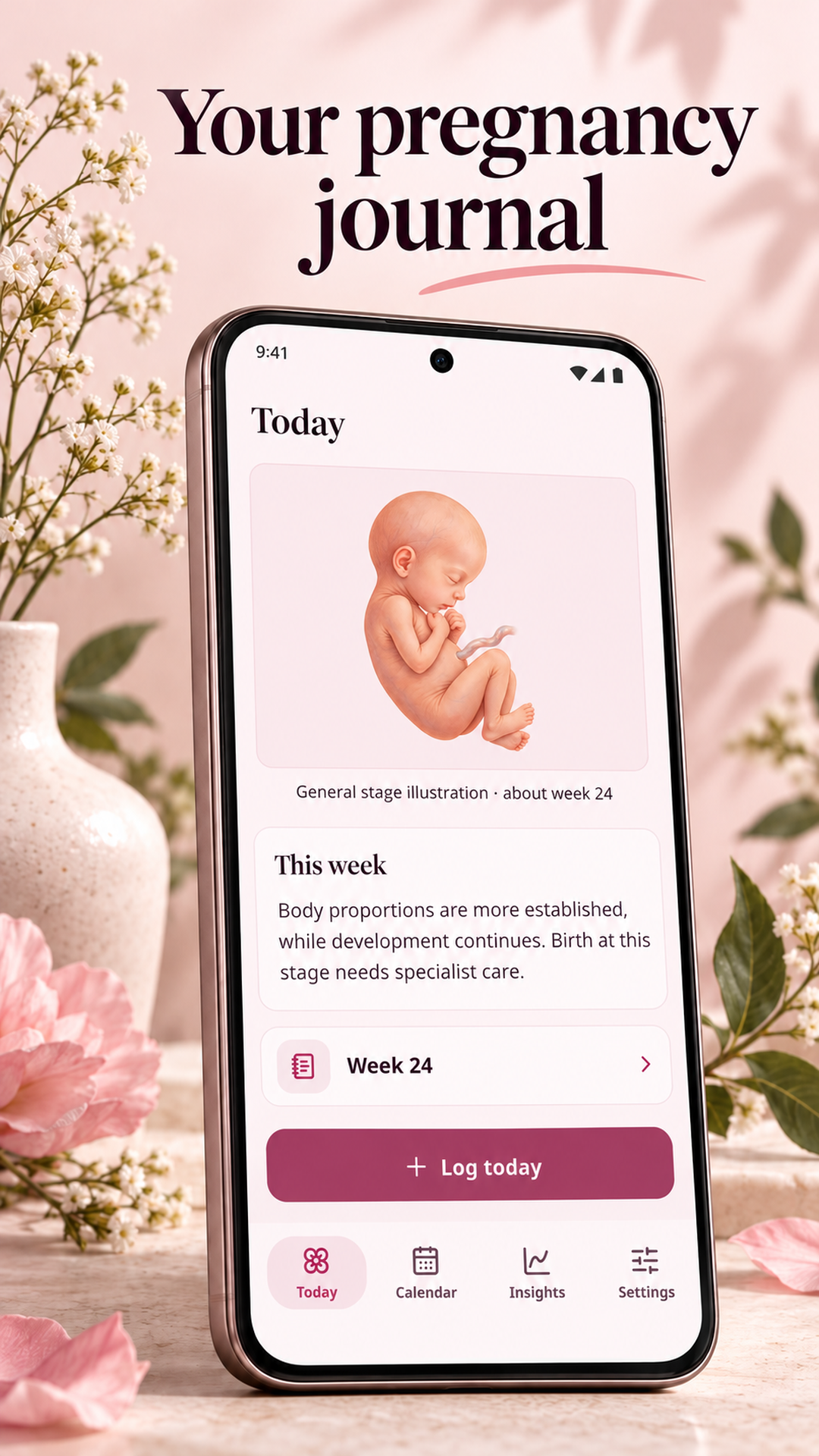
A little more context
For an assumed 28-day cycle, we add 280 calendar days (40 weeks) to the first day of your last period. For another regular cycle length, we add the difference from 28 days. This is a rough calendar model; ovulation does not always follow that pattern.
Yes. In this model, a 30-day cycle moves the estimate two days later than a 28-day cycle. A 26-day cycle moves it two days earlier. Cycle length alone cannot establish when ovulation or conception occurred.
Gestational age is counted in completed weeks and additional days from the pregnancy dating reference, conventionally the first day of the last period. It is usually about two weeks ahead of time since conception. Here, gestational age is calculated from the selected due date and today’s date on your device.
A calendar calculation cannot establish an exact conception date or identify which sexual encounter led to pregnancy. The approximate date shown here is 266 days before the estimated due date. For IVF, we instead label it as an embryo-age fertilisation reference. Neither is a paternity test or a contraceptive tool.
With uncertain or irregular cycles, a period-based estimate may be less reliable. You can explicitly choose an assumed 28-day cycle, or use another method if you have that information. If you do not know your last period, do not guess: your care team can help establish dating.
For ultrasound, enter the scan date and the gestational age on the report. This tool does not interpret measurements or decide whether a due date should change. Early ultrasound can establish or confirm dating. For IVF, the calculation uses the transfer date and embryo age: 263 days after a day-3 transfer or 261 days after a day-5 transfer. Follow your care team’s assigned date.
No. This is a date estimate, not a pregnancy test, diagnosis or prediction of the exact day of birth. Birth can happen before or after an estimated due date. Use the date and guidance your healthcare professional gives you.
This calculator processes dates in your browser memory. It does not send entries or results to Timastra, add them to links, or save them in browser storage. Campaign measurement is disabled on this page. Ordinary website hosting logs still apply. Copying or printing creates a record you control; clear the calculator when you finish on a shared device.
Petalina’s Android app includes free core cycle and pregnancy logging, estimates and health lessons without an app account. Optional paid Plus tools are separate. You can manually enter your date in the app; this page does not transfer calculator entries. Check Google Play for availability on your device and in your country.
General dating information is based on the sources below. Source information checked 1 November 2026; this is not a claim of clinical review or endorsement.
This tool uses date-only calendar arithmetic. It supports current-pregnancy estimates through 42w6d; this is a software limit, not a recommendation about pregnancy duration. It does not interpret scans, assess health or provide a delivery schedule.